It’s likely that you already use a variety of cabling types if your company is considering implementing an organized cabling environment. It is critical to make sure that the cabling solutions you are implementing properly match the specific needs of your business, in addition to considerations of kind and quality. At VastResult, we recognize how crucial it is to choose the ideal cabling infrastructure for your requirements in order to ensure your network operates at peak efficiency and dependability.
Fiber Optic Cables
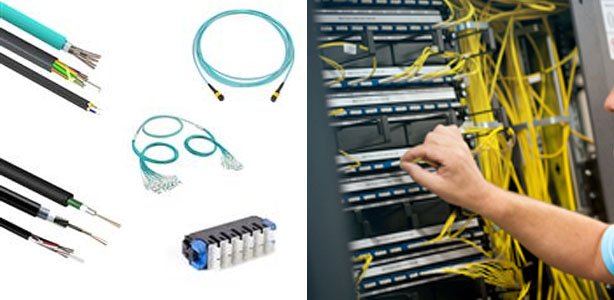
Although fiber optic cables have been around for a while, their increased popularity recently can be attributed to their significantly quicker data transmission speeds when compared to other cabling types. Fiber optic cables work effectively in both indoor and outdoor settings because they don’t require any metal wires or connectors. Although fiber optic cable often costs more than other forms of cabling, its improved performance justifies the difference in price.
Advantages of Fiber Optic Cabling
Faster data transmission rates
Greater bandwidth capacity
Less susceptible to interference than other types of cabling
Suitable for both indoor and outdoor environments
Disadvantages of Fiber Optic Cabling
More expensive than other types of cabling
More difficult to install than other types of cabling
May require infrastructure hardware upgrades
Twisted Pair Cables
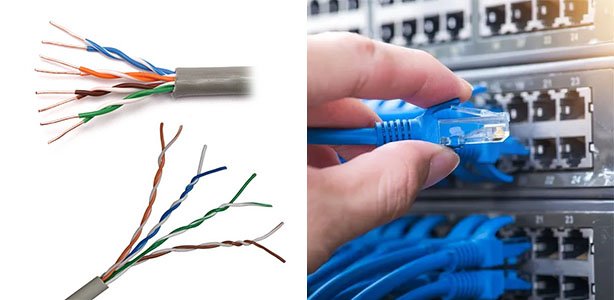
The majority of Ethernet networks use twisted pair wire. Four pairs of thin metal wires, or conductors, make up the cable’s outer sheath or insulation. Every pair is further twisted into many twists. More significantly, these twists aid in preventing signal interference from nearby cables and other devices.
For businesses who need to run connections over long distances, twisted pair cable is an excellent choice. Although twisted pair cabling works best indoors, it is frequently used outdoors in specific applications.
Twisted pair cables that are frequently used include Cat3, Cat5, and Cat 6.
Advantages of Twisted Pair Cables
Inexpensive
Twisted pair cable is a great option for companies who will need to run cables over long distances
Easy to install, work with, and maintain
Industry-standard used in network and computer applications for decades
Disadvantages of Twisted Pair Cables
Cable length restrictions limit the speed at which data is transmitted.
Higher susceptibility to interference from outside sources like power lines or fluorescent lights
May require more infrastructure hardware upgrades than fiber optic cabling for your structured cabling environment. More challenging to install than fiber optic cabling.
Not as well-suited for outdoor applications
Other Types of Cables in a Structured Cabling Environment
There are various other types of cabling in a structured cabling environment. In addition to twisted pair and fiber optic cable, companies often run coaxial cable or telephone wire.
Coaxial Cable
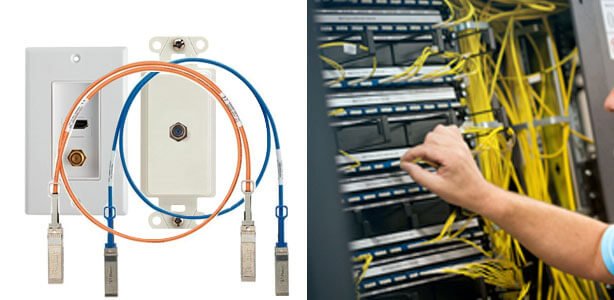
Coaxial cable, also referred to as “co-ax,” is a type of cable in which an inner conductor is encircled by an insulating layer and subsequently by a conductive shield. An insulated outer jacket is often included as well. Signals involving electricity flow through the central conductor.
If you have applications that demand higher speeds, coaxial cable might be a viable solution because it carries data much quicker than telephone wire (see below).
Advantages of Coaxial Cable
Greater bandwidth capacity than other types of cabling
Can be used in both indoor and outdoor environments
Disadvantages of Coaxial Cable
More expensive than other types of cabling
Less flexible and more challenging to work with during installation compared to twisted pair or fiber optic cable
May require infrastructure hardware upgrades
Telephone Wire/Plain Old Telephone Service (POTS) Cables
A business may occasionally require copper phone wire rather than fiber optic or coaxial cable. This usually occurs when a business needs to connect a small number of devices to the network.
Copper phone lines are used by a lot of older credit card POS systems and alarm systems to connect to a landline backup circuit. These are uncommon in a contemporary structured cabling system, nevertheless.
While copper telephone line can be easier to deal with during installation and is significantly more cheap than coaxial or fiber optic cable, it delivers data at slower speeds.
Advantages of Telephone Wire
Much cheaper than coaxial or fiber optic cable
Well suited for companies that only need to connect a few devices
Required for a legacy telephone system or fax system
Disadvantages of Telephone Wire
Data transmission rates are lower than other types of cabling, such as twisted pair and fiber optic cables
May require infrastructure hardware upgrades or unique interfaces
Not well-suited for outdoor applications due to corrosion potential
Subject to theft
Projects and Installations Accomplised
List of projects done
These are the services we have catered so far:
Structured cabling installation
Data Center Setup
Fluke Testing
LAN Cabling Continuity Test
Strip out redundant field cabling
Installation of new Cat6 cabling
Remedial works (Moves/Relocations) for copper cables
Remove cabling from cabinets, remove cabinets, Supply and Install new cabinets
Re-terminate all cabling onto new patch panels and to new cabinet layout